

Infrared (IR) sensors are among the most widely used electronic sensors today. They are found in television remote controls, automatic doors, security systems, robots, smartphones, industrial machines, and many other devices we use every day. Although most people interact with these devices regularly, they often do not realize how the technology behind them actually works.
If you have ever wondered how do IR sensors work, the answer is surprisingly simple. These sensors use infrared light, which is invisible to the human eye, to detect objects, movement, heat, or distance. Instead of using visible light, they rely on infrared radiation that exists naturally around us.
Understanding IR sensors is useful for students, electronics beginners, hobbyists, engineers, and anyone interested in modern technology. Whether you are building an Arduino project or simply curious about how automatic systems detect objects, learning the basics of infrared sensors provides valuable knowledge.
In this guide, you will learn what an IR sensor is, how it works, the main components involved, different types of IR sensors, and where they are commonly used in everyday life.
What Is an IR Sensor?
An IR sensor, or Infrared Sensor, is an electronic device that detects infrared radiation. Infrared light is a type of electromagnetic wave that has a longer wavelength than visible light. Humans cannot see infrared light, but many electronic sensors can detect it.
An IR sensor can perform different tasks depending on its design. Some sensors detect nearby objects, while others measure temperature or identify movement. Because infrared technology is fast, reliable, and inexpensive, it is used across many industries.
The basic purpose of an IR sensor is to convert infrared radiation into an electrical signal. This signal can then be processed by a microcontroller, computer, or electronic circuit to perform a specific action.
For example:
- A TV remote sends infrared signals to the television.
- An automatic door detects someone approaching.
- A robot avoids obstacles.
- A security system detects movement.
- A parking sensor identifies nearby objects.
Although these devices have different purposes, they all rely on infrared sensing technology.
How Do IR Sensors Work?
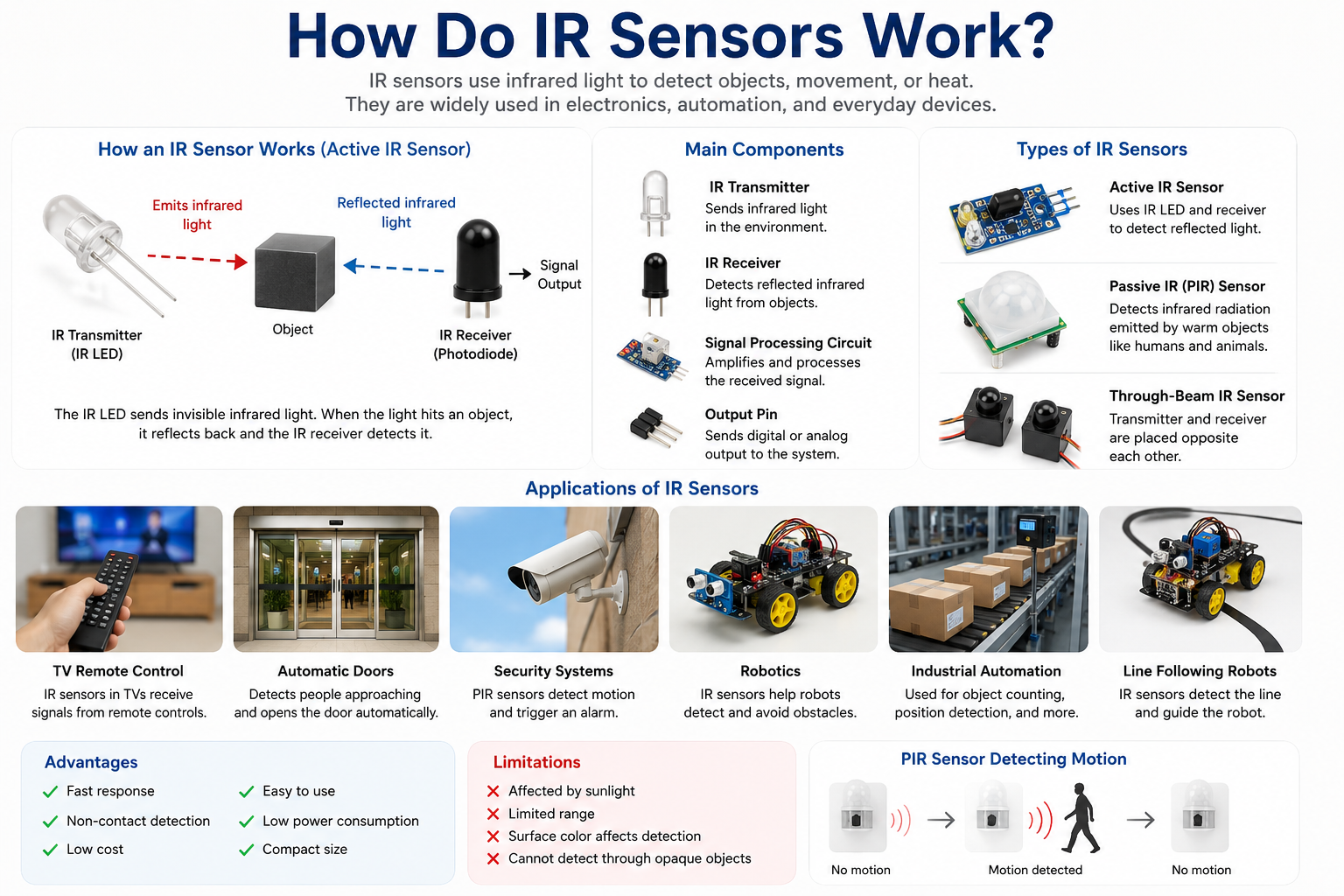
The working principle of an IR sensor depends on the type of sensor being used, but most object detection sensors operate using two main components:
- IR Transmitter
- IR Receiver
The transmitter is usually an infrared LED that continuously emits invisible infrared light.
When no object is present, the emitted infrared light travels away without returning to the sensor.
However, when an object enters the sensing area, the infrared light hits the object and reflects back toward the receiver.
The receiver detects this reflected light and converts it into an electrical signal.
The electronic circuit then analyzes the signal and decides whether an object has been detected.
This process happens almost instantly, making IR sensors suitable for real-time applications such as obstacle detection and automation.
The complete working process can be summarized in five simple steps:
- The IR LED emits invisible infrared light.
- The light travels toward nearby objects.
- An object reflects part of the infrared light.
- The IR receiver detects the reflected light.
- The circuit generates an output signal.
This simple yet effective process allows electronic devices to detect nearby objects without physical contact.
Main Components of an IR Sensor
Understanding the individual components makes it easier to understand how the entire sensor works.
IR Transmitter
The transmitter is usually an infrared LED.
Its job is to produce infrared light continuously or in pulses.
Unlike normal LEDs, infrared LEDs emit light outside the visible spectrum, so the human eye cannot see it.
The strength and angle of the emitted light affect the sensing distance.
IR Receiver
The receiver is typically a photodiode or phototransistor.
Its role is to detect infrared light that returns after reflecting from an object.
The receiver changes the incoming infrared light into electrical current.
The stronger the reflected light, the stronger the electrical signal.
Signal Processing Circuit
The electrical signal produced by the receiver is often very small.
An amplifier and comparator increase the signal strength and determine whether the detected signal exceeds a preset threshold.
This circuit helps reduce false detections caused by noise or environmental conditions.
Many modern IR sensor modules also include adjustable sensitivity using a small potentiometer.
Output Pin
The processed signal is finally sent through an output pin.
This output may be:
- HIGH
- LOW
- Digital
- Analog
The output connects to devices such as:
- Arduino boards
- Raspberry Pi
- PLC controllers
- Industrial automation systems
- Microcontrollers
These controllers then decide what action should happen next.
Types of IR Sensors
Not all IR sensors work in exactly the same way. Different applications require different sensor designs.
Active IR Sensors
Active IR sensors contain both an infrared transmitter and an infrared receiver.
They actively emit infrared light and wait for the reflected signal.
These sensors are commonly used for:
- Obstacle detection
- Distance sensing
- Line-following robots
- Automatic doors
- Conveyor belt monitoring
Since they generate their own infrared light, they work well in controlled environments.
Passive IR Sensors (PIR Sensors)
Passive Infrared Sensors work differently.
Instead of sending infrared light, they detect infrared energy naturally emitted by warm objects such as humans and animals.
Human bodies constantly produce heat in the form of infrared radiation.
When someone walks across the sensor’s detection area, the sensor notices the change in infrared energy and triggers an output signal.
PIR sensors are commonly found in:
- Motion detectors
- Home security systems
- Smart lighting
- Automatic alarms
- Energy-saving lighting systems
Unlike active sensors, PIR sensors do not measure reflected light.
Reflective IR Sensors
Reflective sensors place both the transmitter and receiver on the same side.
They detect objects by measuring reflected infrared light.
These sensors are popular in:
- Robot obstacle avoidance
- Line follower robots
- Industrial counting systems
- Object detection
Through-Beam IR Sensors
In through-beam sensors, the transmitter and receiver are placed opposite each other.
An object is detected when it blocks the infrared beam traveling between them.
These sensors offer greater accuracy and longer sensing distances than reflective sensors.
Common applications include:
- Factory automation
- Packaging systems
- Object counting
- Conveyor monitoring
Where Are IR Sensors Used?
Infrared sensors are everywhere, even if most people never notice them.
Some common applications include:
- Television remote controls
- Automatic hand sanitizer dispensers
- Automatic faucets
- Smart home systems
- Motion detection lights
- Industrial automation
- Robotics
- Object detection
- Parking assistance systems
- Medical equipment
- Contactless switches
- Security alarms
Their low cost, reliability, and fast response make them suitable for both simple and advanced electronic systems.
Advantages of IR Sensors
IR sensors have become popular because they provide a simple, reliable, and affordable way to detect objects and movement. They are used in everything from household electronics to industrial automation because they offer several practical benefits.
Fast Response Time
One of the biggest advantages of IR sensors is their speed. Infrared light travels extremely fast, allowing the sensor to detect objects almost instantly. This quick response is important for systems that need real-time detection, such as automatic doors, robots, and safety equipment.
Non-Contact Detection
IR sensors can detect an object without physically touching it. This reduces wear and tear on equipment and makes the sensors suitable for environments where contact is not possible or desirable.
For example, automatic soap dispensers and touchless faucets use IR sensors to detect a person’s hand without requiring physical contact.
Low Cost
Compared to many other sensing technologies, IR sensors are inexpensive. Their affordability makes them a popular choice for schools, hobby projects, consumer electronics, and large-scale industrial applications.
Easy to Integrate
Most IR sensor modules are designed to work with popular development boards such as Arduino, Raspberry Pi, ESP32, and other microcontrollers. Beginners can often connect an IR sensor using only a few wires and simple programming.
Compact Size
IR sensors are usually small and lightweight. This allows manufacturers to install them inside compact devices such as smartphones, remote controls, robots, and wearable electronics.
Low Power Consumption
Many IR sensors require very little electrical power. Battery-powered devices can therefore use them for long periods without significantly reducing battery life.
Limitations of IR Sensors
Although IR sensors are useful, they are not perfect. Understanding their limitations helps you choose the right sensor for a specific application.
Limited Detection Range
Most standard IR sensors only work over short distances. While some industrial models can detect objects several meters away, many hobby sensors are designed for ranges of only a few centimeters to about one meter.
Sensitivity to Environmental Conditions
Strong sunlight contains infrared radiation, which can interfere with some IR sensors. Bright outdoor environments may reduce detection accuracy if the sensor is not properly designed or shielded.
Surface Reflection Matters
The color and material of an object affect how much infrared light is reflected.
For example:
- White or shiny objects usually reflect more infrared light.
- Black or matte surfaces absorb more infrared light.
Because of this, detection distance may vary depending on the object’s surface.
Cannot See Through Most Objects
Infrared sensors generally cannot detect objects hidden behind walls, thick plastic, or metal. They require a clear path between the transmitter and the object or receiver.
Real-World Examples of IR Sensors
Learning through examples makes it easier to understand how IR sensors work in daily life.
TV Remote Control
Every time you press a button on a TV remote, an infrared LED sends coded infrared signals toward the television.
The TV’s IR receiver recognizes the code and performs the requested action, such as changing the channel or adjusting the volume.
Automatic Doors
Many shopping malls, hospitals, and office buildings use IR sensors near their entrances.
When someone approaches the door, the sensor detects their presence and sends a signal to the door controller, causing the door to open automatically.
Line-Following Robots
Educational robots often use reflective IR sensors to follow a black line on a white surface.
The sensor measures how much infrared light is reflected from the ground:
- White surfaces reflect more infrared light.
- Black lines absorb more infrared light.
The robot continuously adjusts its direction based on these readings.
Motion Sensor Lights
Outdoor security lights commonly use Passive Infrared (PIR) sensors.
When a person walks into the detection area, the sensor detects changes in body heat and turns the light on automatically.
Industrial Conveyor Systems
Factories frequently use through-beam IR sensors to count products moving along conveyor belts. Every time an item interrupts the infrared beam, the system records one product.
IR Sensors vs Other Sensors
Choosing the right sensor depends on the application. Here’s a simple comparison:
| Sensor Type | Detects | Best For |
|---|---|---|
| IR Sensor | Objects, reflected infrared light, or heat | Obstacle detection, automation, remotes |
| Ultrasonic Sensor | Distance using sound waves | Accurate distance measurement |
| PIR Sensor | Body heat and motion | Security systems and motion lights |
| Proximity Sensor | Nearby objects using different technologies | Industrial automation |
| Camera Sensor | Images and visual information | Computer vision and image recognition |
Each sensor has strengths and weaknesses. In many modern systems, multiple sensor types are combined to improve accuracy.
Tips for Using IR Sensors
If you are working with IR sensors in electronics projects, these tips can help improve performance:
- Keep the sensor clean to prevent dust from blocking the infrared light.
- Avoid pointing the sensor directly toward strong sunlight.
- Adjust the sensitivity if your sensor module includes a potentiometer.
- Test the sensor with different object colors and materials.
- Mount the sensor securely to reduce vibration.
- Follow the manufacturer’s recommended operating voltage.
Proper installation and testing can significantly improve detection reliability.
Final Thoughts
Understanding how do IR sensors work helps explain the technology behind many devices we use every day. From TV remote controls and automatic doors to robots, motion detectors, and industrial automation systems, infrared sensors make electronic devices smarter, safer, and more efficient.
At their core, IR sensors work by detecting infrared radiation. Active IR sensors emit invisible infrared light and measure its reflection to identify nearby objects, while passive IR sensors detect infrared energy naturally produced by warm bodies. Both approaches allow devices to respond quickly without physical contact.
As technology continues to evolve, IR sensors remain an important part of automation, robotics, healthcare, security, and consumer electronics. Their affordability, simplicity, and reliability make them one of the most widely used sensing technologies in the world. Whether you are a student, hobbyist, or engineer, learning how do IR sensors work provides a strong foundation for understanding modern electronic systems and developing practical projects.
FAQ
1. What is the main purpose of an IR sensor?
An IR sensor detects infrared radiation to identify objects, movement, heat, or distance. It is widely used in automation, security systems, robotics, consumer electronics, and industrial equipment.
2. How do active and passive IR sensors differ?
Active IR sensors emit infrared light and detect its reflection from nearby objects. Passive IR (PIR) sensors do not emit light; instead, they detect changes in infrared radiation naturally produced by warm objects like people and animals.
3. Can IR sensors work in complete darkness?
Yes. Since IR sensors use infrared radiation rather than visible light, most active IR sensors can detect objects even in complete darkness. However, very bright sunlight may reduce the performance of some models.
4. What devices commonly use IR sensors?
IR sensors are commonly found in TV remote controls, automatic doors, touchless faucets, motion-activated lights, robots, security alarms, parking assistance systems, and factory automation equipment.
5. Are IR sensors better than ultrasonic sensors?
It depends on the application. IR sensors are fast, compact, and inexpensive, making them ideal for short-range object detection. Ultrasonic sensors are often better for measuring longer distances because they use sound waves instead of infrared light. The best choice depends on the environment and the project’s requirements.