

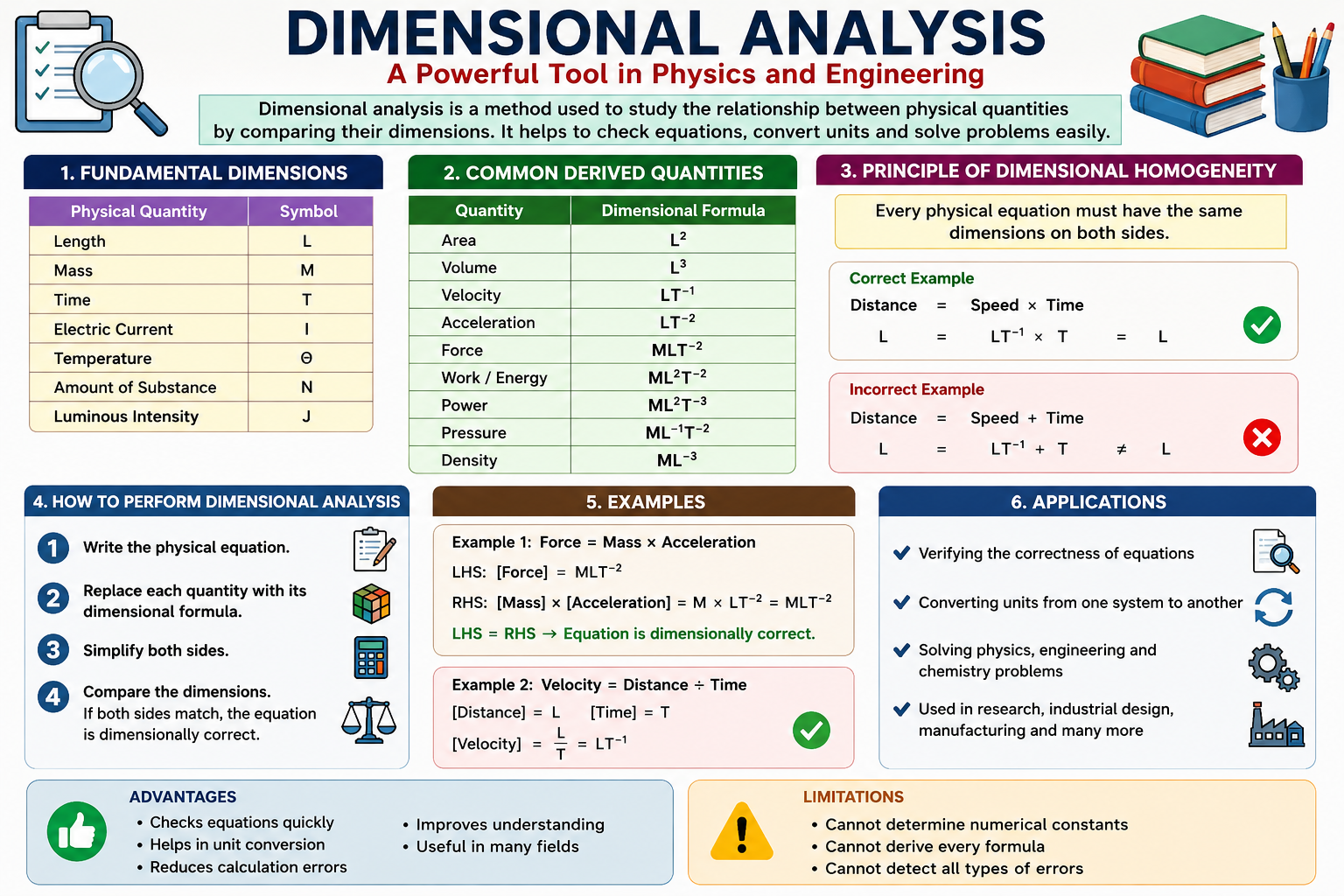
Dimensional analysis is one of the most useful tools in physics, engineering, chemistry, and many other scientific fields. It helps students, researchers, and engineers check whether equations are correct, convert units accurately, and understand the relationship between different physical quantities.
Although the term may sound complicated at first, the basic idea is quite simple. Every physical quantity has dimensions, such as length, mass, or time. By comparing these dimensions, we can verify whether a scientific equation makes sense before solving it.
If you are learning physics or engineering, understanding dimensional analysis will make many topics easier. It improves problem-solving skills, reduces calculation errors, and builds a stronger understanding of scientific formulas.
In this guide, you will learn what dimensional analysis is, why it is important, how it works, its basic principles, practical examples, real-world applications, advantages, and limitations.
What Is Dimensional Analysis?
Dimensional analysis is a mathematical and scientific method used to study the relationship between physical quantities by comparing their dimensions.
Every measurable quantity can be expressed using one or more basic dimensions.
For example:
- Length
- Mass
- Time
- Electric current
- Temperature
- Amount of substance
- Luminous intensity
When scientists write equations, both sides of the equation must represent the same dimensions. If they do not match, the equation is incorrect.
This simple rule makes dimensional analysis an effective way to verify formulas.
Understanding Physical Quantities
Before learning dimensional analysis, it is important to understand physical quantities.
A physical quantity is any property that can be measured.
Examples include:
- Distance
- Speed
- Force
- Energy
- Pressure
- Temperature
- Velocity
- Power
Each quantity has:
- A numerical value
- A unit
- A dimension
For example:
Distance = 20 meters
Here:
- Quantity = Distance
- Value = 20
- Unit = meter (m)
- Dimension = Length (L)
Fundamental Dimensions
Most scientific calculations are based on a small group of fundamental dimensions.
These are:
| Physical Quantity | Symbol |
|---|---|
| Length | L |
| Mass | M |
| Time | T |
| Electric Current | I |
| Temperature | Θ |
| Amount of Substance | N |
| Luminous Intensity | J |
Many derived quantities are created by combining these fundamental dimensions.
Derived Quantities
Derived quantities are formed by combining two or more basic dimensions.
Examples include:
| Quantity | Dimensional Formula |
|---|---|
| Area | L² |
| Volume | L³ |
| Velocity | LT⁻¹ |
| Acceleration | LT⁻² |
| Force | MLT⁻² |
| Work | ML²T⁻² |
| Energy | ML²T⁻² |
| Power | ML²T⁻³ |
| Pressure | ML⁻¹T⁻² |
| Density | ML⁻³ |
Learning these dimensional formulas makes it easier to solve scientific problems.
What Is a Dimensional Formula?
A dimensional formula shows how a physical quantity depends on the fundamental dimensions.
Instead of using measurement units, it uses symbols such as:
- L
- M
- T
For example:
Velocity
Velocity = Distance ÷ Time
Distance has dimension:
L
Time has dimension:
T
Therefore,
Velocity = LT⁻¹
Similarly,
Force = Mass × Acceleration
Mass = M
Acceleration = LT⁻²
Therefore,
Force = MLT⁻²
These formulas are widely used in physics and engineering.
Principle of Dimensional Homogeneity
The most important rule in dimensional analysis is called the Principle of Dimensional Homogeneity.
It states:
Every correct physical equation must have the same dimensions on both sides.
For example,
Distance = Speed × Time
Dimensions become:
Left side
L
Right side
(LT⁻¹) × T
= L
Both sides have the same dimension.
Therefore, the equation is dimensionally correct.
Now consider this incorrect equation:
Distance = Speed + Time
Dimensions become:
Left side
L
Right side
LT⁻¹ + T
These dimensions are different.
Therefore, the equation is not physically correct.
Why Is Dimensional Analysis Important?
Dimensional analysis provides several important benefits.
It Checks Equations
Scientists can quickly verify whether equations are dimensionally correct before performing calculations.
This reduces mistakes in research and engineering.
It Helps Convert Units
Unit conversion becomes much easier using dimensional analysis.
For example:
- Kilometers to meters
- Hours to seconds
- Miles to kilometers
- Pounds to kilograms
This method ensures conversions remain accurate.
It Simplifies Problem Solving
Instead of memorizing every formula, students can sometimes derive relationships using dimensions.
This improves conceptual understanding.
It Reduces Errors
Many calculation mistakes happen because of incorrect units.
Dimensional analysis helps identify these errors early.
How to Perform Dimensional Analysis
The process is straightforward.
Step 1
Write the physical equation.
Step 2
Replace each quantity with its dimensional formula.
Step 3
Simplify both sides.
Step 4
Compare the dimensions.
If both sides match, the equation is dimensionally correct.
If they do not match, there is an error.
Example 1: Checking an Equation
Suppose we have:
Force = Mass × Acceleration
Dimensions:
Force
MLT⁻²
Mass
M
Acceleration
LT⁻²
Right side
M × LT⁻²
= MLT⁻²
Both sides match.
Therefore, the equation is correct.
Example 2: Velocity Formula
Velocity = Distance ÷ Time
Distance
L
Time
T
Therefore,
Velocity
LT⁻¹
The dimensional formula is correct.
Real-World Applications of Dimensional Analysis
Dimensional analysis is not limited to classrooms.
It plays an important role in many industries.
Engineering
Engineers use dimensional analysis while designing:
- Bridges
- Buildings
- Machines
- Vehicles
- Aircraft
It helps verify formulas before construction begins.
Physics
Physicists use dimensional analysis to:
- Verify equations
- Study motion
- Understand energy
- Analyze forces
- Develop new scientific models
Chemistry
Chemists use dimensional analysis for:
- Unit conversions
- Chemical calculations
- Laboratory measurements
- Concentration calculations
Medicine
Healthcare professionals often use dimensional analysis when converting medication dosages and measurement units.
Accurate conversions reduce the risk of medical errors.
Manufacturing
Factories use dimensional analysis during product design, testing, and quality control to ensure measurements remain consistent.
Advantages of Dimensional Analysis
Dimensional analysis offers many practical benefits in science, engineering, and everyday calculations. It helps users solve problems more accurately while improving their understanding of physical relationships.
Helps Verify Equations
One of the biggest advantages of dimensional analysis is that it can quickly determine whether a physics equation is dimensionally correct.
If the dimensions on both sides of an equation do not match, there is clearly a mistake that needs to be corrected before performing calculations.
Reduces Calculation Errors
Many errors occur because incorrect units are used.
For example, mixing meters with centimeters or hours with seconds can produce incorrect answers.
Dimensional analysis helps identify these mistakes before they become larger problems.
Makes Unit Conversion Easier
Converting units becomes much simpler with dimensional analysis.
Common conversions include:
- Kilometers to meters
- Centimeters to meters
- Hours to seconds
- Miles to kilometers
- Pounds to kilograms
Using conversion factors correctly ensures accurate results.
Improves Conceptual Understanding
Instead of memorizing formulas without understanding them, students learn how different physical quantities relate to one another.
This makes topics in physics and engineering easier to understand.
Useful Across Many Subjects
Dimensional analysis is not limited to physics.
It is also useful in:
- Engineering
- Chemistry
- Mathematics
- Environmental science
- Medical calculations
- Scientific research
Because measurements are used in almost every scientific field, dimensional analysis has wide practical value.
Limitations of Dimensional Analysis
Although dimensional analysis is extremely useful, it also has some limitations.
It Cannot Prove an Equation Is Completely Correct
A dimensionally correct equation may still be mathematically incorrect.
For example, dimensional analysis cannot determine whether a numerical constant such as 2, π (pi), or ½ should appear in a formula.
It only checks whether the dimensions are consistent.
It Cannot Derive Every Formula
Some scientific equations include trigonometric functions, logarithms, or exponential terms.
Dimensional analysis alone cannot derive these relationships.
Additional mathematical methods are required.
It Does Not Detect All Errors
If an equation contains the correct dimensions but uses the wrong physical relationship, dimensional analysis may not detect the mistake.
For this reason, it should always be used alongside proper scientific reasoning.
Common Mistakes Students Make
Beginners often make similar mistakes while learning dimensional analysis.
Some of the most common include:
- Confusing units with dimensions.
- Forgetting to convert units before calculations.
- Adding or subtracting quantities with different dimensions.
- Memorizing dimensional formulas without understanding them.
- Ignoring negative powers in dimensional expressions.
Carefully checking each step can help avoid these errors.
Tips for Learning Dimensional Analysis
If you are new to the topic, these simple tips can help you learn faster.
Memorize the Fundamental Dimensions
Start by remembering the basic dimensions:
- Length (L)
- Mass (M)
- Time (T)
Once these become familiar, deriving other formulas becomes much easier.
Practice Derived Quantities
Regularly practice writing dimensional formulas for common quantities such as:
- Velocity
- Force
- Energy
- Pressure
- Density
- Power
The more examples you solve, the more confident you will become.
Check Every Equation
Whenever you learn a new physics formula, compare the dimensions on both sides.
This habit strengthens your understanding and helps prevent mistakes.
Solve Unit Conversion Problems
Practice converting between different units using dimensional analysis.
This improves both speed and accuracy.
Dimensional Analysis in Everyday Life
Although it is mostly taught in science classes, dimensional analysis also appears in everyday situations.
Examples include:
- Converting kilometers to miles while traveling.
- Changing cooking measurements from cups to milliliters.
- Calculating fuel efficiency.
- Measuring ingredients in recipes.
- Reading medicine dosage instructions.
- Comparing product sizes and weights.
These simple tasks all involve converting or comparing measurements correctly.
Dimensional Analysis vs Unit Analysis
People sometimes confuse dimensional analysis with unit analysis.
Although they are closely related, they are not exactly the same.
| Dimensional Analysis | Unit Analysis |
|---|---|
| Uses dimensions such as L, M, and T | Uses measurement units such as meter, kilogram, and second |
| Checks whether equations are dimensionally consistent | Converts one unit into another |
| Commonly used in physics and engineering | Commonly used in everyday measurements and calculations |
| Focuses on relationships between physical quantities | Focuses on measurement conversions |
Both methods are valuable and are often used together when solving scientific problems.
Final Thoughts
Understanding dimensional analysis is an essential step for anyone studying physics, engineering, chemistry, or other scientific subjects. It provides a simple but powerful way to verify equations, understand physical quantities, and perform accurate unit conversions.
By learning the basic dimensions, understanding dimensional formulas, and applying the principle of dimensional homogeneity, students can solve problems more confidently while reducing calculation errors.
Although dimensional analysis cannot replace mathematical proofs or experimental testing, it remains one of the most valuable tools in science. Whether you are preparing for exams, working on engineering projects, or simply trying to understand how physical equations work, mastering dimensional analysis will strengthen your problem-solving skills and improve your understanding of the scientific world.
FAQ
1. What is dimensional analysis in simple words?
Dimensional analysis is a scientific method used to check whether equations are correct by comparing the dimensions of physical quantities. It is also widely used for converting measurement units accurately.
2. Why is dimensional analysis important in physics?
It helps verify equations, reduce calculation errors, perform unit conversions, and improve the understanding of relationships between physical quantities.
3. What are the fundamental dimensions?
The seven fundamental dimensions are Length (L), Mass (M), Time (T), Electric Current (I), Temperature (Θ), Amount of Substance (N), and Luminous Intensity (J).
4. What is the difference between dimensions and units?
Dimensions describe the physical nature of a quantity, such as Length (L) or Mass (M), while units are the standard measurements used to express those quantities, such as meters, kilograms, or seconds.
5. What are the limitations of dimensional analysis?
Dimensional analysis cannot determine numerical constants, prove an equation is mathematically complete, or derive every scientific formula. It checks dimensional consistency but should be used together with mathematical analysis and experimental evidence.